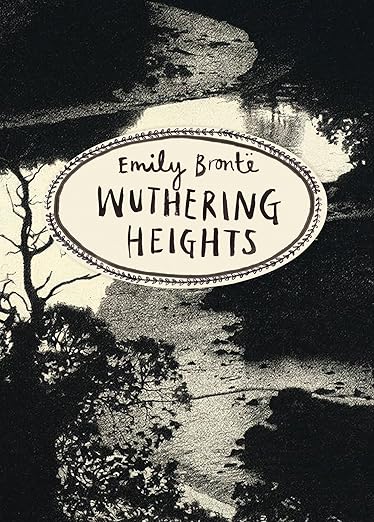
Heathcliff digs up Catherine’s grave so he can hold her body. He marries a woman just to torture her. He systematically destroys everyone connected to the person who rejected him. And for 175 years, readers have sighed and said, “But that’s true love.”
Emily Brontë didn’t write a romance. She wrote an autopsy of obsession. We just keep mistaking the corpse for something beautiful.
She was born in 1818 in Yorkshire, one of six Brontë children. Her mother died when she was three. The surviving siblings: Charlotte, Branwell, Emily, Anne, grew up in a parsonage on the edge of the moors with a distant father. So they created worlds. Built imaginary kingdoms and wrote thousands of pages about them. Emily and Anne shared Gondal: their private universe, their obsession, their entire emotional life.
Emily barely left Yorkshire. Tried teaching once, and she hated it. Went to Brussels with Charlotte, and still hated it. Came back to the moors. They were her world: harsh, wild, indifferent to human suffering. That landscape became “Wuthering Heights”.
She published it in 1847 under the name “Ellis Bell” because women didn’t write like this. Women wrote gentle romances where virtue triumphed. Emily wrote Heathcliff.
Catherine Earnshaw loves Heathcliff with absolute, destructive totality. “I am Heathcliff” she says. Not “I love him », I “am” him. But she marries Edgar Linton instead. She chooses comfort over wildness, stability over chaos. And Heathcliff makes everyone pay.
He becomes wealthy, returns, marries Edgar’s sister Isabella and treats her so cruelly she flees. He acquires Wuthering Heights, ruins Catherine’s brother, raises the next generation to continue the abuse. Catherine dies in childbirth. Heathcliff begs her ghost to haunt him. Spends twenty years obsessed, seeing her everywhere, unable to live or die. When he finally dies, he’s smiling, reunited with her in whatever hell they’ve made together.
This is what people call the greatest love story ever written?
Here’s what Emily actually wrote: love without boundaries becomes violence. Obsession masquerades as devotion. Two people can destroy everyone around them and call it fate. Catherine and Heathcliff don’t save each other, they annihilate each other and everyone they touch.
Critics were horrified and called it “coarse,” “brutal,” “repulsive.” Emily had violated every Victorian rule. The “Quarterly Review” said it was “a compound of vulgar depravity and unnatural horrors.”
They weren’t wrong. Emily wasn’t trying to uplift anyone. She was telling the truth about possession masquerading as love.
She died a year later of tuberculosis. She was thirty, refused medical treatment, refused to admit she was sick, kept walking the moors until she couldn’t anymore. December 1848. One novel and some devastating poetry, that’s all she left.
But what a novel.
Because “Wuthering Heights” is about love as annihilation. Catherine wants Heathcliff’s soul but not his poverty or wildness. She tells Nelly Dean: “Whatever our souls are made of, his and mine are the same.” But she won’t marry him because it would “degrade” her. She wants him to be someone else while remaining exactly himself. It’s impossible. It destroys them both.
Heathcliff loves her so completely he can’t let her be a separate person. Can’t accept her choices, can’t survive her choosing someone else. So he spends decades making everyone suffer. That’s not romance, that’s pathology.
But Emily wrote it so intensely, with such conviction, that we keep reading it as aspirational. Keep swooning over Heathcliff’s devotion. Keep missing that devotion and abuse aren’t opposites, sometimes they’re the same thing with different names.
Emily knew the moors. Knew beautiful things can kill you, knew nature is indifferent, that loving something wild doesn’t make it safe. She put that knowledge into every page, the Heights harsh and cold, passion versus peace, wildness versus civilization. We’re supposed to see that passion isn’t always good. That sometimes the gentle choice is right, even if it doesn’t feel as intense.
But we don’t see it. We read Wuthering Heights and want what Catherine and Heathcliff have: that soul-deep, impossible love. We want to be haunted. We want “I am Heathcliff” even as Emily shows us exactly where it leads.
She died at thirty having written one perfect, terrible book. Never married, never left Yorkshire for long, never explained. She just wrote the truth about obsession and let us call it romance.
This Valentine’s Day, people are calling Wuthering Heights the most romantic classic. They’re not wrong to love it. They’re wrong about what it is.
It’s not a love story. It’s a warning.
Emily just wrote it so beautifully we can’t tell the difference.

