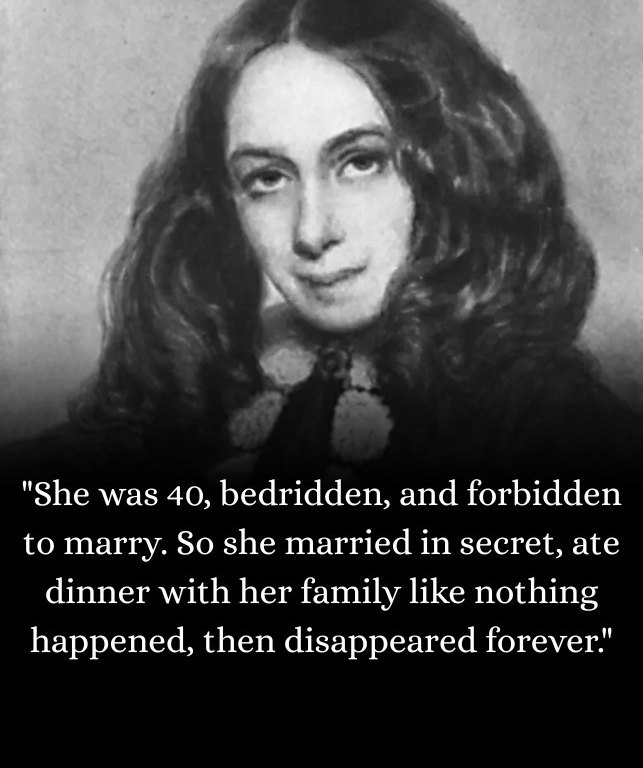
She was 40, bedridden, and forbidden to marry. So she married in secret, ate dinner with her family like nothing happened, then disappeared forever.
London, 1840s. Elizabeth Barrett was expected to die.
For years she had lived almost entirely in one room at 50 Wimpole Street, weakened by chronic illness no doctor could explain. Medicine dulled the pain but deepened the isolation.
Everyone agreed: her life would be short.
Her father ruled the household with absolute authority. Edward Barrett Moulton-Barrett had twelve children and one unbreakable rule—none of them were ever allowed to marry.
Marriage meant independence. Independence meant losing control.
Elizabeth’s body was restricted, but her mind was not. She poured herself into poetry. While she remained hidden in a darkened room, her work traveled far beyond it.
She became one of the most respected poets in England, admired across Europe by readers who never saw her face.
Then a letter arrived.
“I love your verses with all my heart.”
It was from Robert Browning—a poet six years younger, bold and curious. He didn’t write to a fragile invalid. He wrote to an equal.
One letter became many. Over twenty months, they exchanged 570 letters. He visited her quietly. He challenged her thinking. He treated her as alive.
When he asked her to marry him, she said no.
Her father would destroy them. Her health was too poor. Her life too constrained.
Robert disagreed. He told her she was the strongest person he knew.
On September 12, 1846, Elizabeth Barrett walked into St Marylebone Parish Church with only her maid as witness.
She married Robert Browning without announcement, without permission, without her family knowing.
Then she did something extraordinary.
She went home. She removed nothing from her routine. She sat at the family dinner table and said nothing.
For an entire week, she lived as a married woman in her father’s house without anyone knowing.
Then on September 19, 1846, she left for good.
She took her dog Flush. She took Robert’s hand. She walked out of the house that had confined her for nearly ten years.
Her father disowned her instantly. He rejected every letter she sent unopened. He never spoke her name again.
To him, she no longer existed.
But in Italy, Elizabeth began to live.
The woman believed too weak to survive started walking again. Traveling. Climbing stairs.
At forty-three, she gave birth to a son.
Her writing surged with new energy and clarity. She produced Sonnets from the Portuguese—some of the most enduring love poetry in English literature, including the famous “How do I love thee? Let me count the ways.”
She wrote boldly about politics, slavery, and freedom. She criticized the very plantation wealth her family had depended on.
Her work was so respected that her name was mentioned for Poet Laureate—the highest literary honor in Britain.
Robert didn’t eclipse her voice. He supported it. He celebrated it. He treated her as the literary equal she was.
They shared fifteen years together in Italy. Fifteen years she was never supposed to have.
She died in Florence in 1861 at age fifty-five. Her father had died three years earlier, still unforgiving.
By then, his approval no longer mattered.
Elizabeth Barrett Browning’s story is not about being rescued by love.
It’s about understanding that what was destroying her wasn’t illness—it was control.
Sometimes survival means leaving. Sometimes courage looks like standing up at forty, supposedly too weak to live, and walking straight into your own life.
Elizabeth didn’t just endure. She wrote. She traveled. She raised a child. She changed literature.
The bravest thing she ever did was walk out the door.
Elizabeth Barrett Browning
March 6, 1806 – June 29, 1861
Poet. Rebel. Survivor.
She didn’t need saving. She needed freedom.
 POSITIVE SOCIAL IMPACT - Where Growth & Soulful collaborations happen